
An Integrated Model of Actual Digital Health Adoption: A Cross-Sectional PLS-SEM Study on Indonesia's National Health Insurance App

Keywords
eHealth literacy Technology Acceptance Model Social Influence PLS-SEM digital health adoption Mobile JKN national health insuranceAbstract
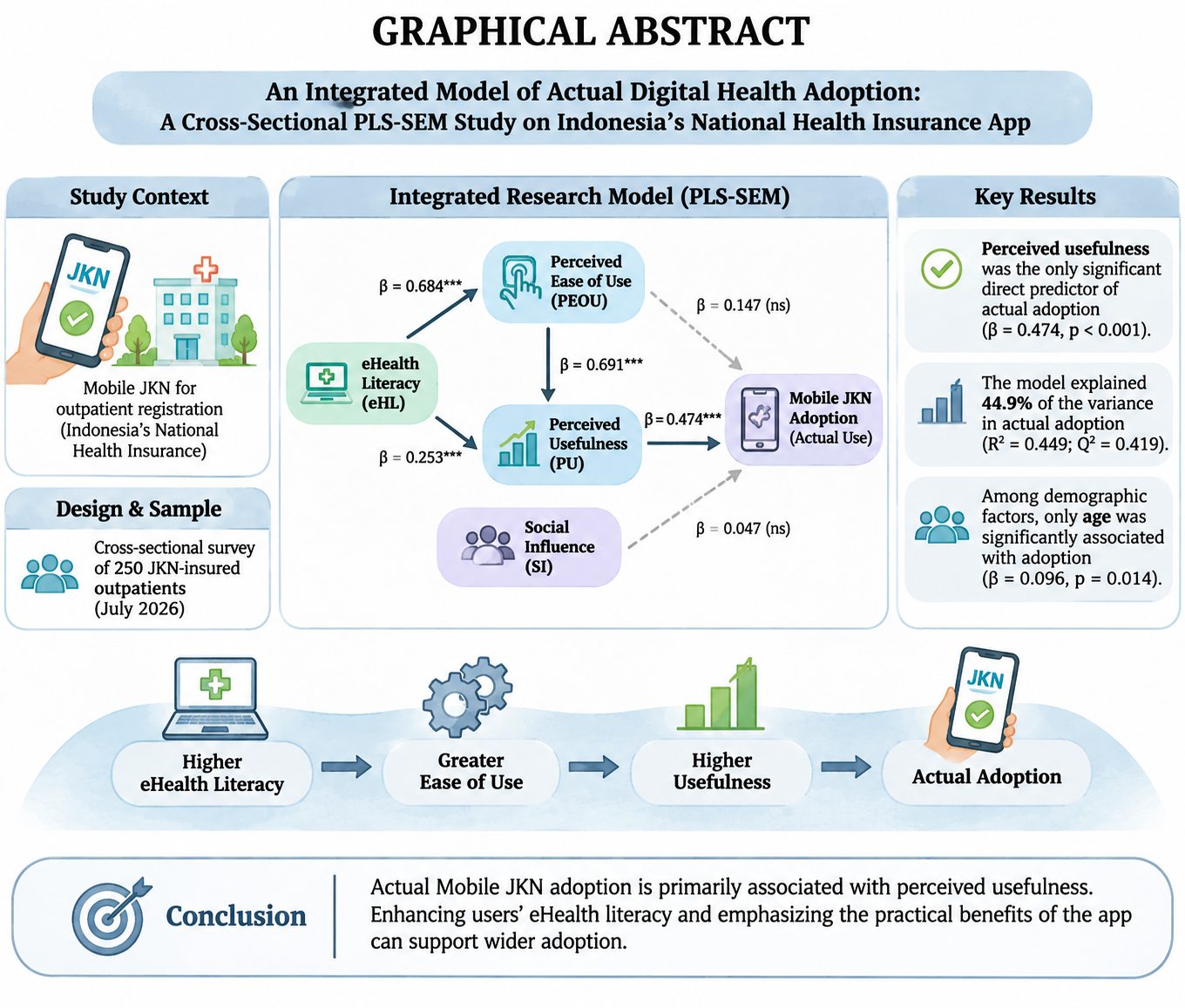
Background: Although Indonesia's National Health Insurance (JKN) participation has reached 98.6%, utilization of Mobile JKN for outpatient registration remains low and uneven. Previous research has generally applied the Technology Acceptance Model (TAM) or the Unified Theory of Acceptance and Use of Technology (UTAUT) separately, neglected eHealth literacy, and measured usage intentions rather than actual adoption behavior. Objective: examining the roles of eHealth literacy, perceived ease of use (PEOU), perceived usefulness (PU), and social influence (SI) in explaining actual Mobile JKN adoption— controlling for sociodemographic factors. Methods: A cross-sectional survey of 250 JKN-insured outpatients was conducted in July 2026 at Primaya Hospital Tangerang, Indonesia. Adoption was defined as self-reported use of Mobile JKN for outpatient registration at the last visit or in the previous three months. Data analysis used Partial Least Squares Structural Equation Modeling (PLS-SEM) with 5,000 bootstrap samples. Results: eHealth literacy significantly predicted PEOU (β = 0.684) and PU (β = 0.253), while PEOU significantly predicted PU (β = 0.691) (all p < 0.001). PU was the only significant direct predictor of actual adoption (β = 0.474, p < 0.001); PEOU and SI were not significant. PU fully mediated the effect of PEOU on adoption. Among sociodemographic variables, only age was significantly associated with adoption (β = 0.096, p = 0.014). The model explained 44.9% of the variance in actual adoption (R² = 0.449; Q² = 0.419). Conclusions: Actual Mobile JKN adoption is driven primarily by perceived usefulness rather than ease of use or social influence. Integrating eHealth literacy with a technology acceptance framework provides a more comprehensive explanation of digital health adoption and supports healthcare interventions that emphasize practical benefits for users alongside enhanced digital capabilities.References
1. BPJS Kesehatan. Laporan Pengelolaan Program Jaminan Sosial Kesehatan sampai dengan 31 Desember 2025. Jakarta: BPJS Kesehatan; 2026.
2. World Bank. Lessons from Indonesia's 10-year journey towards universal health coverage. Washington (DC): World Bank; 2026. Available from: World Bank publication
3. World Health Organization. Does Indonesia's National Health Insurance Scheme mobile phone application, Mobile JKN, support health financing? Geneva: World Health Organization; 2024. Available from: WHO Publications
4. Rahmadani S, Feisha AL, Palutturi S, Balqis B, Abadi MY. Factors influencing the utilization of the Mobile JKN health application in Indonesia. J Public Health Pharm. 2025;5(3):512–521.
5. Damanik FS, Widayanti AW, Wiedyaningsih C. User acceptance of Mobile-JKN: Insights from the Technology Acceptance Model. Jurnal Administrasi Kesehatan Indonesia. 2024;12(2):206–217.
6. Pratama ZS, Suhartanto D. Encouraging the intention to use Mobile JKN application for patient registration and appointment in Indonesia: a cross-sectional study. J Public Health Res Community Health Dev. 2025;8(2):97–108.
7. Davis FD. Perceived usefulness, perceived ease of use, and user acceptance of information technology. MIS Q.1989;13(3):319–340.
8. Sukma Nela A, Patria A, Prayetni P. Determinants of perceived benefits and ease of use of the JKN Mobile App among outpatients: a cross-sectional study. Jurnal Manajemen Informasi Kesehatan (Health Information Management).2026;11(1):266–276.
9. Norman CD, Skinner HA. eHEALS: The eHealth Literacy Scale. J Med Internet Res. 2006;8(4):e27.
10. Kayser L, Kushniruk A, Osborne RH, Norgaard O, Turner P. Enhancing the effectiveness of consumer-focused health information technology systems through eHealth literacy: A framework for understanding users' needs. JMIR Hum Factors. 2015;2(1):e9. doi:10.2196/humanfactors.3696.
11. van Kessel R, Wong BLH, Clemens T, Brand H. Digital health literacy as a super determinant of health: More than simply the sum of its parts. Internet Interv. 2022;27:100500.
12. Venkatesh V, Morris MG, Davis GB, Davis FD. User acceptance of information technology: Toward a unified view. MIS Q. 2003;27(3):425–478.
13. Sheeran P. Intention–behavior relations: A conceptual and empirical review. Eur Rev Soc Psychol. 2002;12(1):1–36. doi:10.1080/14792772143000003.
14. Webb TL, Sheeran P. Does changing behavioral intentions engender behavior change? A meta-analysis of the experimental evidence. Psychol Bull. 2006;132(2):249–268. doi:10.1037/0033-2909.132.2.249.
15. Alviani R, Purwandari B, Eitiveni I, Purwaningsih M. Factors Affecting Adoption of Telemedicine for Virtual Healthcare Services in Indonesia. J Inf Syst Eng Bus Intell. 2023;9(1):47-69. doi:10.20473/jisebi.9.1.47-69.
16. Hair JF Jr, Hult GTM, Ringle CM, Sarstedt M. A Primer on Partial Least Squares Structural Equation Modeling (PLS-SEM). 3rd ed. Thousand Oaks (CA): Sage Publications; 2022.
17. Fornell C, Larcker DF. Evaluating structural equation models with unobservable variables and measurement error. J Mark Res. 1981;18(1):39–50.
18. King WR, He J. A meta-analysis of the Technology Acceptance Model. Inf Manag. 2006;43(6):740–755.
19. Zhao X, Lynch JG Jr, Chen Q. Reconsidering Baron and Kenny: Myths and truths about mediation analysis. J Consum Res. 2010;37(2):197–206.
20. DeLone WH, McLean ER. The DeLone and McLean model of information systems success: A ten-year update. J Manag Inf Syst. 2003;19(4):9–30.
21. Bhattacherjee A. Understanding information systems continuance: An expectation-confirmation model. MIS Q. 2001;25(3):351–370.
22. Venkatesh V, Davis FD. A theoretical extension of the Technology Acceptance Model: Four longitudinal field studies.Manage Sci. 2000;46(2):186–204.
23. Limayem M, Hirt SG, Cheung CMK. How habit limits the predictive power of intention: The case of information systems continuance. MIS Q. 2007;31(4):705–737.
24. Van Deursen AJAM, van Dijk JAGM. Internet skills and the digital divide. New Media Soc. 2011;13(6):893–911. doi:10.1177/1461444810386774.
25. Czaja SJ, Charness N, Fisk AD, Hertzog C, Nair SN, Rogers WA, et al. Factors predicting the use of technology: Findings from the Center for Research and Education on Aging and Technology Enhancement (CREATE). Psychol Aging.2006;21(2):333–352.
26. Andersen RM. Revisiting the Behavioral Model and Access to Medical Care: Does it Matter? J Health Soc Behav.1995;36(1):1–10.
27. Bandura A. Self-efficacy: The Exercise of Control. New York: W.H. Freeman; 1997.
28. World Health Organization. Global Strategy on Digital Health 2020–2025. Geneva: World Health Organization; 2021.
Downloads
Published
How to Cite
Issue
Section
License
Copyright (c) 2026 Journal of Public Health Industry

This work is licensed under a Creative Commons Attribution-NonCommercial-ShareAlike 4.0 International License.