Bridging the Dispensing-to-Home Gap: A Conceptual Framework for Medication Information Continuity in Proxy Prescription Collection

Keywords
Continuity of Patient Care Hospital Pharmacy Service Health Literacy Caregivers Digital HealthAbstract
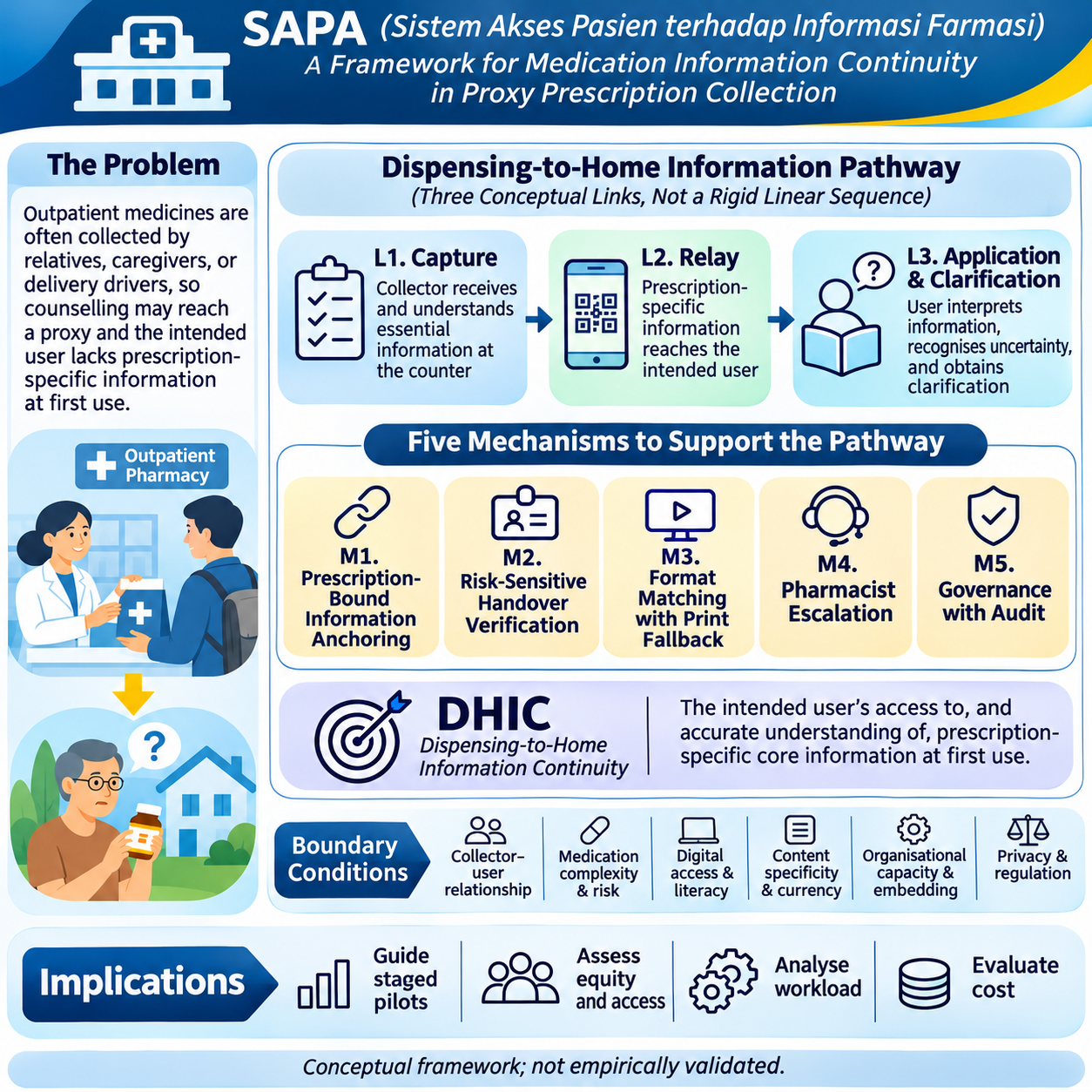
Background: Outpatient hospital pharmacies increasingly dispense medicines to relatives, caregivers, or delivery drivers rather than to the person who will use them, so counselling may reach a proxy and leave the intended user without prescription-specific information at first use. This conceptual paper develops SAPA (Sistem Akses Pasien terhadap Informasi Farmasi), a mechanism-level framework for sustaining medication information continuity across the dispensing-to-home transition. Methodology: We applied conceptual framework analysis, adapted to a single-team process, using purposive narrative mapping of literature on medication continuity, digital medication education, teach-back, health literacy, caregiver medication management, and technology adoption, together with a problem-scoping case from an Indonesian outpatient pharmacy. Results: The synthesis defines dispensing-to-home information continuity (DHIC) as the intended user's access to, and accurate understanding of, prescription-specific core information at first use. DHIC is decomposed into capture, relay, and application-and-clarification links, matched to five mechanisms: prescription-bound information anchoring, risk-sensitive handover verification, format matching with print fallback, pharmacist escalation, and governance with audit. We specify boundary conditions, design tensions, eight falsifiable propositions, and a measurement architecture. Conclusions: SAPA offers a testable account of how electronic medical record data can support patient-facing medication information when collector and user differ. It is not empirically validated and does not demonstrate improved safety, adherence, efficiency, or sustainability. Implications: The framework gives pharmacy managers and digital-health planners a basis for staged pilots, equity assessment, workload analysis, and cost evaluation.
References
1. World Health Organization. Medication safety in transitions of care. Geneva: World Health Organization; 2019. Report No.: WHO/UHC/SDS/2019.9.
2. World Health Organization. Global patient safety action plan 2021–2030: towards eliminating avoidable harm in health care. Geneva: World Health Organization; 2021.
3. Donaldson LJ, Kelley ET, Dhingra-Kumar N, Kieny MP, Sheikh A. Medication Without Harm: WHO's third global patient safety challenge. Lancet. 2017;389(10080):1680–1. doi:10.1016/S0140-6736(17)31047-4
4. Tomlinson J, Cheong VL, Fylan B, Silcock J, Smith H, Karban K, et al. Successful care transitions for older people: a systematic review and meta-analysis of the effects of interventions that support medication continuity. Age Ageing. 2020;49(4):558–69. doi:10.1093/ageing/afaa002
5. Carpenter DM, Abraham O, Alexander DS, Horowitz K. Counseling of children and adolescents in community pharmacies: results from a 14-day observational study. J Am Pharm Assoc. 2016;56(3):266–269.e1. doi:10.1016/j.japh.2016.03.001.
6. Look KA, Stone JA. Medication management activities performed by informal caregivers of older adults. Res Social Adm Pharm. 2018;14(5):418–426. doi:10.1016/j.sapharm.2017.05.005.
7. Astutik NI, Malihah S, Pattinaya VO. SAPA MITRA FARMASI (Sistem Akses Pasien terhadap Informasi Farmasi): inovasi pelayanan kesehatan digital dan keselamatan pasien [project-based learning report]. Master of Pharmacy Program, Faculty of Pharmacy, Universitas Pancasila; 2026. Unpublished Report.
8. Haggerty JL, Reid RJ, Freeman GK, Starfield BH, Adair CE, McKendry R. Continuity of care: a multidisciplinary review. BMJ. 2003;327(7425):1219–1221. doi:10.1136/bmj.327.7425.1219.
9. Talevski J, Wong Shee A, Rasmussen B, Kemp G, Beauchamp A. Teach-back: a systematic review of implementation and impacts. PLoS One. 2020;15(4):e0231350. doi:10.1371/journal.pone.0231350.
10. O'Mahony E, Kenny J, Hayde J, Dalton K. Development and evaluation of pharmacist-provided teach-back medication counselling at hospital discharge. Int J Clin Pharm. 2023;45(3):698–711. doi:10.1007/s11096-023-01558-0.
11. Karia CT, Hughes A, Carr S. Uses of quick response codes in healthcare education: a scoping review. BMC Med Educ. 2019;19:456. doi:10.1186/s12909-019-1876-4.
12. Yong WY, Chang CT, Chew CC, Khoo TE. Interactive virtual medication counselling in outpatient pharmacy: an accessible and safe patient counselling method during the COVID-19 pandemic. Res Social Adm Pharm. 2021;17(10):1860–1862. doi:10.1016/j.sapharm.2021.07.002.
13. Pouliot A, Vaillancourt R, Stacey D, Suter P. Defining and identifying concepts of medication literacy: an international perspective. Res Social Adm Pharm. 2018;14(9):797–804. doi:10.1016/j.sapharm.2017.11.005.
14. World Health Organization. WHO guideline: recommendations on digital interventions for health system strengthening. Geneva: World Health Organization; 2019.
15. Mahajan M, Hogewoning JA, Zewald JJA, et al. The impact of teach-back on patient recall and understanding of discharge information in the emergency department: the Emergency Teach-Back (EM-TeBa) study. Int J Emerg Med. 2020;13:49. doi:10.1186/s12245-020-00306-9.
16. Wali H, Hudani Z, Wali S, Mercer K, Grindrod K. A systematic review of interventions to improve medication information for low health literate populations. Res Social Adm Pharm. 2016;12(6):830–864. doi:10.1016/j.sapharm.2015.12.001.
17. van Kessel R, Wong BLH, Clemens T, Brand H. Digital health literacy as a super determinant of health: more than simply the sum of its parts. Internet Interv. 2022;27:100500. doi:10.1016/j.invent.2022.100500.
18. Greenhalgh T, Wherton J, Papoutsi C, Lynch J, Hughes G, A'Court C, et al. Beyond adoption: a new framework for theorizing and evaluating nonadoption, abandonment, and challenges to the scale-up, spread, and sustainability of health and care technologies. J Med Internet Res. 2017;19(11). doi:10.2196/jmir.8775.
19. Rogers EM. Diffusion of innovations. 5th ed. New York: Free Press; 2003.
20. Proctor E, Silmere H, Raghavan R, Hovmand P, Aarons G, Bunger A, et al. Outcomes for implementation research: conceptual distinctions, measurement challenges, and research agenda. Adm Policy Ment Health. 2011;38(1):65–76. doi:10.1007/s10488-010-0319-7.
21. Manias E, Bucknall T, Hughes C, Jorm C, Woodward-Kron R. Family involvement in managing medications of older patients across transitions of care: a systematic review. BMC Geriatr. 2019;19:95. doi:10.1186/s12877-019-1102-6.
22. Ozavci G, Bucknall T, Woodward-Kron R, Hughes C, Jorm C, Joseph K, et al. A systematic review of older patients' experiences and perceptions of communication about managing medication across transitions of care. Res Social Adm Pharm. 2021;17(2):273–291. doi:10.1016/j.sapharm.2020.03.023.
23. Lipovec NC, Zerovnik S, Kos M. Pharmacy-supported interventions at transitions of care: an umbrella review. Int J Clin Pharm. 2019;41(4):831–852. doi:10.1007/s11096-019-00833-3.
24. Jabareen Y. Building a conceptual framework: philosophy, definitions, and procedure. Int J Qual Methods. 2009;8(4):49–62.
25. Whetten DA. What constitutes a theoretical contribution? Acad Manage Rev. 1989;14(4):490–5.
26. Jaakkola E. Designing conceptual articles: four approaches. AMS Rev. 2020;10:18–26.
27. Walker LO, Avant KC. Strategies for theory construction in nursing. 6th ed. New York: Pearson; 2019.
28. Donabedian A. The quality of care: how can it be assessed? JAMA. 1988;260(12):1743–8.
29. Kementerian Kesehatan Republik Indonesia. Keputusan Menteri Kesehatan Nomor HK.01.07/MENKES/1128/2022 tentang Standar Akreditasi Rumah Sakit. Jakarta: Kementerian Kesehatan RI; 2022.
30. Kementerian Kesehatan Republik Indonesia. Peraturan Menteri Kesehatan Nomor 24 Tahun 2022 tentang Rekam Medis. Jakarta: Kementerian Kesehatan RI; 2022.
31. Kementerian Kesehatan Republik Indonesia. Peraturan Menteri Kesehatan Nomor 72 Tahun 2016 tentang Standar Pelayanan Kefarmasian di Rumah Sakit. Jakarta: Kementerian Kesehatan RI; 2016.
32. Republik Indonesia. Undang-Undang Nomor 27 Tahun 2022 tentang Pelindungan Data Pribadi. Jakarta; 2022.
33. World Health Organization. Global strategy on digital health 2020–2025. Geneva: World Health Organization; 2021.
34. Republik Indonesia. Undang-Undang Nomor 17 Tahun 2023 tentang Kesehatan. Jakarta; 2023.
Downloads
Published
How to Cite
Issue
Section
License
Copyright (c) 2026 Journal of Public Health Industry

This work is licensed under a Creative Commons Attribution-NonCommercial-ShareAlike 4.0 International License.