Call for paper
2026-02-25
Call for paper
Read more about Call for paperAn International, Peer-Reviewed Open Access Journal
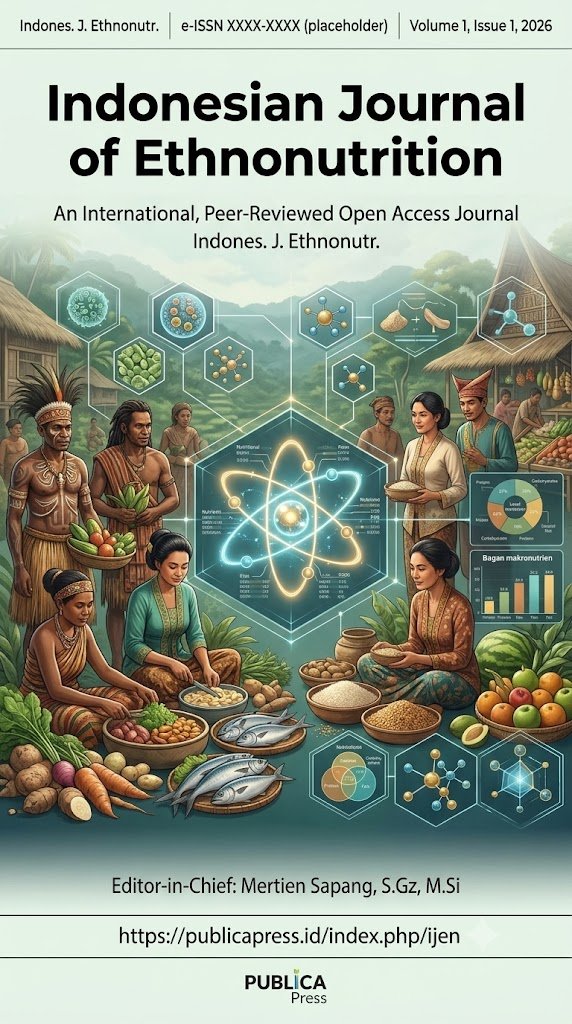
The Indonesian Journal of Ethnonutrition (Indones. J. Ethnonutr.) is a peer-reviewed academic journal dedicated to the interdisciplinary study of nutrition, culture, and traditional food systems. The journal serves as a platform for researchers, academicians, and practitioners to document, analyze, and disseminate empirical findings regarding the dietary practices and indigenous nutritional knowledge of various ethnic groups, both within Indonesia and globally.
By exploring the intersection of anthropology, ethnobotany, and nutritional science, this journal aims to contribute to a broader understanding of how cultural heritage, local food biodiversity, and traditional food processing methods influence human health, dietary adequacy, and community well-being.
| Editor-in-Chief | Mertien Sapang, S.Gz., M.Si. |
| Journal Abbreviation | Indones. J. Ethnonutr. |
| Peer-Review Process | Peer-reviewed |
| Management Style | Open Access |
The journal welcomes original research articles, systematic reviews, and short communications that fall within the following areas:




Indonesian Journal of Ethnonutrition
Published by: Publica Press
Powered By:
Public Knowledge Project (PKP)
Copyright © 2026 Indonesian Journal of Ethnonutrition, All rights reserved.
This is an open-access article distributed under the terms of the Creative Commons Attribution 4.0 International License.
Licensed under  a Creative Commons Attribution 4.0 International License.
Site using Salnesia Theme